Le tradizioni più antiche della festa di mezzo inverno prevedevano una sorta di questua benaugurale in cui un gruppo di giovani andava di casa in casa con “The Old Tup“; l’usanza si riscontra in particolare a Derby e a Chersterfield[1] portata avanti dai Mummers della contea ancora durante l’Ottocento e ripresa fino ai nostri giorni: si metteva in scena la morte rituale di un ariete, il cui sangue anticamente veniva raccolto in una ciotola e la carne era distribuita ai poveri.
Durante la pantomima viene ancora oggi cantata la canzone di questua “The Derby Ram/Tup”
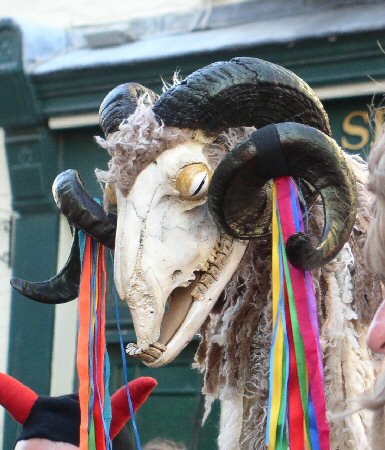
Oggi la pantomima prevede la partecipazione di svariati personaggi tra i quali non può mancare il macellaio che uccide l’ariete, e un imbonitore che richiede il denaro tra il pubblico.
Così leggiamo nelle note del video: Il vecchio montone o il montone di Derby è una pantomima associata alle visite in casa durante il periodo natalizio nella zona di Sheffield.
Il Tup è simile all’ Hooden nella struttura: una testa su un palo con mascelle a scatto e corna di montone, trattenuta da un operatore coperto da un panno per rappresentare il corpo. La rappresentazione è accompagnata dal canto della vecchia canzone popolare “The Derby Ram” ed è la storia di come il montone viene macellato e trasformato in oggetti utili e ambiti per la gente del posto. Altri personaggi includono il suo custode, Beelzebub e Little Devil Doubt che sollecitano le donazioni con minacce! “
[english version]
The oldest traditions of the mid-winter festival included an auspicious quest in which a group of young people went from house to house with “The Old Tup“; the custom is found in particular in Derby and Chersterfield[1] carried on by the Mummers of the county still during the nineteenth century and up to our days: they rapresent the ritual death of a ram, whose blood in ancient times was collected in a bowl and the meat was distributed to the poor.
Today the pantomime involves the participation of various characters among which the butcher who kills the ram, and a barker who requests money from the public.
VIDEO The Derby Tup, Performed by the Handsworth Sword Dancers, Boxing Day 2011.
“The Derby Tup is also known as Old Tup or the Derby Ram and is a mumming play associated with house visiting customs around Christmas time in the Sheffield area. The Tup is similar to the Hooden Horse in construction — a head on a pole with snapping jaws and rams horns, held by an operator covered by a cloth to represent the body. The play is accompanied by the singing of the widespread old folk song “The Derby Ram” and is the story of how the ram is butchered and made into useful and desirable items for the local people to use. Other characters include his keeper and Beelzebub and Little Devil Doubt who solicit for donations with menaces!”
Derby Ram, il canto di questua
[ Roud 126 ; Master title: The Derby Ram ; G/D 3:645 ; TYG 59 ; AFS 28 ; Ballad Index R106 ; VWML RoudFS/S142381 ; Bodleian Roud 126 ; GlosTrad Roud 126 ; Wiltshire 51 , 257 ; DT DERBYRAM , DERBYRM7 ; Mudcat 95630 ; trad.]
L’Old Tup è una figura propiziatoria assimilabile all’Hooden Horse, un’offerta sacrificale per ottenere la benevolenza degli dei affinché accordassero abbondanza e prosperità alla terra. Con il tempo il significato del rituale si è confuso e la canzone è diventata una canzonaccia o è finita nelle nursery rhymes come canzoncina umoristica ma è anche diventata una sea shanty in cui un ariete gigantesco compie imprese prodigiose.
The Old Tup is a propitiatory figure similar to the Hooden Horse, a sacrificial offering to obtain the benevolence of the gods, so that they could grant abundance and prosperity to the land. Over time, the meaning of the ritual became confused and we have a bawdy song, a humorous ditty for children and a sea shanty too –Derby Ram sea shanty in which the ram became gigantic and performs prodigious deeds.
traduzione italiana di Cattia Salto
Mentre andavo a Derby
in un giorno di mercato
ho visto il più grande ariete
che mai si sia mai nutrito di fieno
La lum lay lum people lay lum lay(1)
L’ariete era grosso davanti, signore
l’ariete era grosso dietro
l’ariete era largo nove piedi, signore
e anche un po’ più
Le corna su questo ariete crescevano
fino a raggiungere il cielo.
Le aquile ci facevano il nido
si potrebbero sentire i lamenti dei piccoli!
Si le corna su questo ariete crescevano
fino a raggiungere la luna.
Un ragazzino ci salì a Gennaio
e non fu di ritorno che a Giugno
E tutti gli uomini di Derby
vennero a chiedere la sua coda
per suonare la campana a morto di San Giorgio(2)
dalla cima del carcere di Derby.
E tutte le donne di Derby
vennero a chiedere le sue orecchie
per farne grembiali di pelle
che durassero 40 anni.
E tutti i giovani di Derby
vennero a chiedere i suoi occhi
per farne dei palloni
perché erano della misura di una palla da calcio.
Ci sono voluti tutti gli uomini di Derby
per portare via le sue ossa
e tutte le donne di Derby
per far rotolare via le sue tonsille(3).
E ora che la storia è finita
e non mi resta altro da dire
vi prego di darci un’offerta per l’anno nuovo
e noi andremo via.
NOTE
(1) coro alternativo
[e così ragazzi, è vero, ragazzi
non sono notoriamente un bugiardo
e se andrete a Derby
potrete vederlo come ho fatto io]
(2) secondo la tradizione le campane sono suonate in occasione di un decesso per impedire ai diavoli di catturare l’anima del defunto
(3) letteralmente stones si traduce con pietre ma in questo contesto credo voglia dire tonsille
The Watersons version
1.As I was going to Derby,
all on a market day
I’ve spied the biggest ram, sir,
that ever was fed on hay
La lum lay lum people lay lum lay(1)
2.This tup was fat behind, sir,
this tup was fat before
This tup was nine feet round, sir,
if not a little more
3.And the horns upon this tup they grew,
well they reached up to the sky
The eagles made their nests within,
you could hear the young ones cry
4.Yes the horns that on this tup they grew,
well they reached up to the moon
A little boy went up in January
and he never got back till June
5.And all the men of Derby
come begging for his tail
To ring St George’s passing bell(2)
from the top of Derby Gaol
6.And all the women of Derby
come begging for his ears
To make ‘em leather aprons
to last ‘em forty years
7.And all the boys of Derby
come begging for his eyes
To make themselves some footballs
cause they were of football size
8.Took all the men of Derby
to carry away his bones
Took all the women of Derby
to roll away his stones
9.And now my story is over,
and I have no more to say
Please give us all a New Year’s box
and we will go away
FOOTNOTES
(1) alternative chorus:
And indeed, my lads, it’s true, my lads,
I never was known to lie
And if you’d been in Derby,
you’d seen him the same as I
(2) according to tradition the bells are ringed on the occasion of a death to prevent the devils from capturing the soul of the deceased
La versione appalachiana
Questa versione comica dei Monti Appalachi ricorda ancora il rituale di macellazione e lo smembramento dell’ariete
This appalachian comic version, still remembers the old ritual of slaughtering and the ram dismemberment
traduzione italiana di Cattia Salto
Mentre andavo a Derby
in un giorno di mercato
ho visto il più grande ariete
che mai si sia mai nutrito di fieno
E lui gironzolava
dentro e fuori la città
e gironzolò finché i macellai
lo abbatterono
L’ariete aveva quattro zampe, signore
quattro zampe su cui reggersi
e ogni suo zoccolo, signore,
ricopriva 40 acri di terra
La lana del suo dorso, signore
raggiungeva il cielo
Le aquile ci facevano il nido
potresti sentire i piccoli gridare
Le corna sulla sua testa, signore
raggiungevano la luna;
un uomo ci salì a Gennaio
e fu di ritorno a Giugno
La lana che cresceva sulla sua coda
se l’avessi tosato
avrebbe reso ai migliori sarti
un centinaio di iarde di stoffa
Il macellaio che lo ha abbattuto, signore
è annegato nel sangue
e l’aiutante che teneva la ciotola
è stato spazzato via dal flusso.
1.As I went in to Darby,
All on a Market Day,
I saw the largest ram, sir,
That was ever fed on hay.
And he rambled, rambled all around
In and out of town did he ramble,
And he rambled til them butchers
cut him down.
2.This ram had four feet, sir,
Four feet on which to stand,
And each one of his hooves sir,
covered an 40 acres of land.
3.The wool upon his back, sir,
It reached up to the sky;
The eagles made their nests there,
You could hear the young ones cry.
4.The horns upon his head, sir,
They reached up to the moon;
A man climbed up in January,
And didn’t come down ‘til June.
5.The wool that grew upon his tail,
If you had sheared it off,
Would have made the finest tailors
A hundred yards of cloth.
6.The Butcher that cut him down sir,
He drownded in the blood.
And the little boy who held the bowl,
Was washed away in the flood.
[1] https://en.wikipedia.org/wiki/Old_Tup
http://www.yorkshirefolksong.net/song.cfm?songID=59
http://calendarcustoms.com/articles/derby-tup/
https://folkplay.info/resources/texts-and-contexts/old-tup-braithwell-1895
https://folkplay.info/resources/texts-and-contexts/old-tup-castleton-1901
https://folkplay.info/resources/texts-and-contexts/little-tup-carlton-lindrick-notts-1906
https://folkplay.info/resources/texts-and-contexts/old-tup-staveley-mrgascoynes-version-1946
https://folkplay.info/resources/texts-and-contexts/towd-tup-eckington-1969-0
le varianti delle versioni da canzonaccia
https://maxhunter.missouristate.edu/songinformation.aspx?ID=197
https://mudcat.org/@displaysong.cfm?SongID=6163
FONTI
https://mainlynorfolk.info/lloyd/songs/thederbyram.html
https://andyirvinelyrics.wordpress.com/2014/02/12/the-derby-ram/
http://www.classic-rocks.com/english-irish-folk-music/the-derby-ram.html
varianti americane
https://maxhunter.missouristate.edu/songinformation.aspx?ID=0271
https://maxhunter.missouristate.edu/songinformation.aspx?ID=0295
https://maxhunter.missouristate.edu/songinformation.aspx?ID=0525
http://www.wtv-zone.com/phyrst/audio/nfld/12/derbyram.htm
http://www.wtv-zone.com/phyrst/audio/nfld/21/ram.htm
http://www.wtv-zone.com/phyrst/audio/nfld/22/derbyram.htm
http://www.wtv-zone.com/phyrst/audio/nfld/27/darbyram.htm
versioni australiane
https://folkstream.com/028.html
